

EMCORE is home to many innovative technology advancements in the inertial navigation products business.
For over 50 years, EMCORE has been at the forefront of innovation in inertial navigation technology. As a trusted leader in the industry, we have consistently pushed the boundaries of performance, precision, and reliability across mission-critical applications. Our deep engineering expertise and commitment to technological advancement have positioned EMCORE as a driving force in the evolution of navigation solutions for aerospace, defense, and commercial markets.
Inertial navigation technology is a method of determining an object’s position, orientation, and velocity without relying on external references like GPS.
Instead, it uses internal sensors to continuously calculate motion from a known starting point. This makes it especially valuable in environments where signals are unavailable or unreliable, such as underwater, underground, or in space.
At the core of an inertial navigation system (INS) are two main types of sensors: accelerometers and gyroscopes. Accelerometers measure linear acceleration along different axes, while gyroscopes measure rotational motion. By combining data from these sensors, the system can track how an object moves and rotates over time.
The process begins with a known initial position and orientation. As the object moves, accelerometers detect changes in velocity by measuring acceleration. These measurements are integrated over time to estimate speed and displacement. Meanwhile, gyroscopes track changes in orientation, ensuring that movement is calculated in the correct direction. A computer continuously processes this data to update the object’s position in real time.
One key advantage of inertial navigation is its independence from external signals. Unlike GPS, it cannot be jammed or blocked. This makes it essential for applications like aircraft navigation, submarines, spacecraft, and military systems. It also provides very fast and continuous updates.
However, inertial navigation has a major limitation: drift. Small measurement errors in sensors accumulate over time, leading to increasing inaccuracies in position estimates. To counter this, INS is often combined with other systems, such as GPS or radar, in a hybrid approach that improves overall accuracy.
Overall, inertial navigation technology is a powerful and self-contained system that enables precise movement tracking, especially in challenging or signal-denied environments.
TYPES OF INERTIAL NAVIGATION TECHNOLOGY
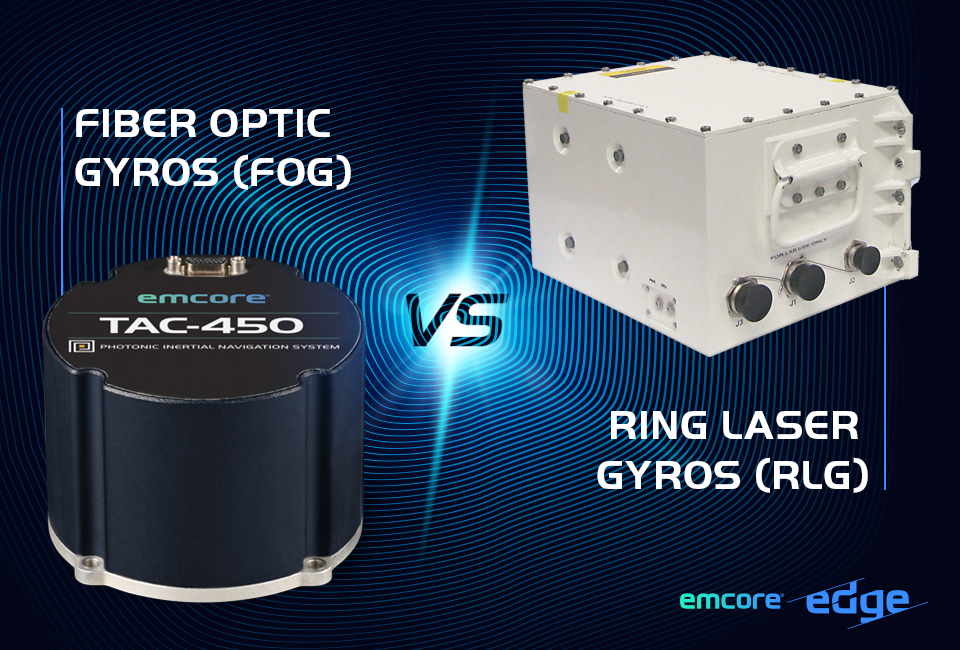
Fiber Optic Gyros vs Ring Laser Gyro Technologies
Fiber Optic Gyroscopes (FOGs) and Ring Laser Gyroscopes (RLGs) are both precision instruments used to measure rotation based on the Sagnac effect, but they differ in design and operation. Read more about the main features and benefits of each below.
Fiber Optic Gyroscopes (FOGs)
FOGs use long coils of optical fiber through which light travels in opposite directions. When the device rotates, a phase shift occurs between the two light beams, which is detected interferometrically. FOGs have no moving parts, making them highly reliable, resistant to wear, and less sensitive to mechanical shock. They are also relatively compact and easier to manufacture.
- No moving parts – reliable, low maintenance
- Immune to electromagnetic interference
- Compact, scalable, and cost-efficient
- Fast response and wide dynamic range
Ring Laser Gyroscopes (RLGs)
RLGs, on the other hand, use a closed-loop laser cavity where two laser beams travel in opposite directions. Rotation causes a frequency difference (beat frequency) between the beams. RLGs require precise mirrors and often use mechanical dithering to overcome “lock-in” effects at low rotation rates. They are typically more complex and expensive than FOGs but have historically offered very high accuracy.
- Precision and long-term stability
- Proven technology in high-end aerospace
- Sensitivity for very small rotations
Advantages
Fiber Optic Gyroscopes (FOGs) offer several advantages over Ring Laser Gyroscopes (RLGs). FOGs have no moving parts or internal mirrors, making them more durable and less sensitive to mechanical wear. They are also immune to lock-in effects that can affect RLGs at low rotation rates, eliminating the need for mechanical dithering. FOGs generally provide higher reliability, longer lifespan, and lower maintenance requirements. Additionally, they are more compact and easier to manufacture, often resulting in lower costs. Their resistance to environmental factors like vibration and temperature changes makes them especially suitable for modern navigation systems in aerospace, marine, and autonomous applications.
FOG (Fiber Optic Gyroscope) and RLG (Ring Laser Gyroscope) are both highly accurate optical navigation technologies, but FOG is more modern, cost-effective, and robust due to its solid-state design with no moving parts. It is widely used in commercial, marine, and industrial systems. RLG offers extremely high precision and long-term stability, making it ideal for aerospace and military systems. However, it is complex, expensive, and requires maintenance. Overall, RLG is best for maximum accuracy, while FOG is better for practicality, reliability, and cost.