
Illuminating a new era of Fiber Optic Gyro performance – groundbreaking EMCORE Photonic Integrated Chip (PIC) reinvents FOG technology.
The EMCORE inertial systems with PIC Inside™ deliver robust reliability and survivability in the harshest environments, while offering the critical navigation support that autonomous platforms and other applications require. EMCORE is proud that all of its inertial and gyro products are made in the USA.
INNOVATION
Innovation is embedded in our foundation.
From pioneering fiber optic gyroscopes and advanced inertial measurement units to delivering highly integrated navigation systems, EMCORE continues to set new standards in accuracy, durability, and performance. Our products are designed to operate in the most demanding environments, supporting platforms where precision and dependability are non-negotiable.
At EMCORE, innovation is more than a milestone — it is our ongoing commitment to shaping the future of navigation technology.
Backed by decades of research, rigorous testing, and customer collaboration, EMCORE remains dedicated to advancing next-generation inertial navigation capabilities. We combine heritage expertise with forward-looking vision, ensuring that our solutions not only meet today’s requirements, but anticipate tomorrow’s challenges.
What is PIC Technology?
Photonic Integrated Circuit (PIC) Technology
Photonic Integrated Circuit (PIC) technology is radically transforming inertial navigation with smaller, lighter, and more robust optical sensing systems that integrate multiple optical components onto a single semiconductor chip, including lasers, modulators, detectors, and waveguides. Compared to traditional discrete optical assemblies, this technology significantly reduces size, weight, power consumption, and overall system complexity.
A photonic integrated circuit (PIC) or integrated optical circuit is a microchip containing two or more photonic components that form a functioning circuit. This technology detects, generates, transports, and processes light. Photonic integrated circuits use photons (or particles of light) as opposed to electrons that are used by electronic integrated circuits. The major difference between the two is that a photonic integrated circuit provides functions for information signals imposed on optical wavelengths typically in the visible spectrum or near-infrared (850–1650 nm).
EMCORE Integrates PIC into FOG Technology and takes inertial navigation to a whole new performance level.
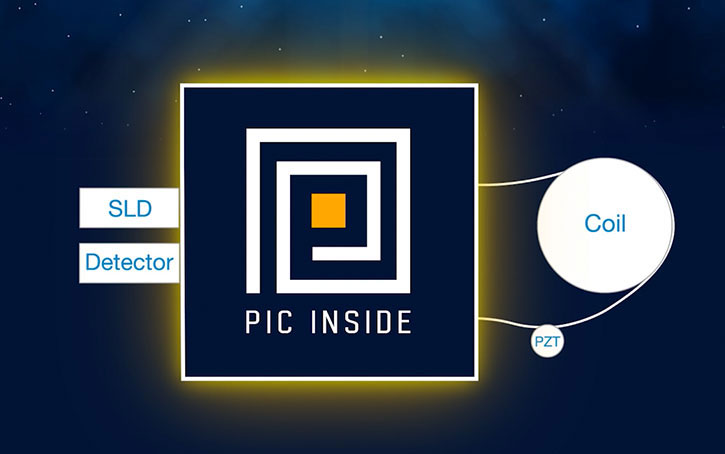
EMCORE patented* Photonic Integrated Chip (PIC) expands FOG technology with the integrated planar optical chip. EMCORE gyros and inertial systems with PIC Inside™ provide:
- Flexible, modular designs for easy integration
- Outstanding repeatability unit-to-unit
EMCORE inertial systems with PIC Inside™ deliver robust reliability and survivability in the harshest environments while offering the critical navigation support that autonomous platforms and other applications require.
Integrated Photonics for Precision Navigation
In Inertial Navigation Systems (INS), precise measurement is paramount. While Fiber Optic Gyroscopes (FOGs) and other optical sensors rely on light interference to measure rotation, PIC technology advances this measurement capability by providing highly stable, integrated optical paths that improve signal integrity and reduce environmental sensitivities. The PICs’ monolithic nature minimizes alignment errors and mechanical drift for improved long-term stability and repeatability.
Manufacturing & Scalability
Beyond performance improvements, PIC-based inertial sensors offer meaningful manufacturing and scalability advantages by using semiconductor fabrication processes for high-volume, repeatable production with tighter tolerances and lower variability. This leads to greater reliability and cost efficiency, making advanced inertial navigation accessible across many aerospace, defense, autonomous vehicle and industrial applications.
PIC technology also produces a more rugged device with fewer discrete components and interconnects that make systems more resistant to vibration, shock, and temperature extremes — critical factors for deployment in demanding environments such as aircraft, spacecraft, naval systems, and precision-guided platforms.
PIC-based inertial sensors:
- Incorporate complex elements onto a chip to improve accuracy and performance, as well as simplify production and remove hand work from the process
- Provide consistent manufacturing to ensure consistent component performance and reliability
- Enable precision inertial system mass-production
- Rigorous Testing & Qualification
*Protected by U.S. Patent # 10,274,319. Additional patents pending.
Ensuring performance through rigorous testing & qualification
Part Level – Testing includes over temperature cycling, temperature and humidity, and shock and vibration, all run over multiple lots of parts to validate the repeatability and robustness of manufacturing.
Product Level – Testing is done across the complete set of performance specifications and environmental conditions and repeated over time to validate the design.